
Section 2 | Chapter 1
Finding Your Conceptual Identity
Visual Course Map
Course Cheat Sheet
Resources:
Conceptual Identity
What is a Conceptual Identity?
Out of the three elements of your Artistic Identity, your Conceptual Identity is easily the most ambiguous. However it is also the most important place to start. Think of it this way—if Visual Identity is what you can see, and Sonic Identity is what you can hear, then Conceptual Identity is what you feel. It’s the heart of what the artist represents to the listener. It is the subliminal narrative that will run through nearly all that you do, and that will give the listener context when listening to your music.
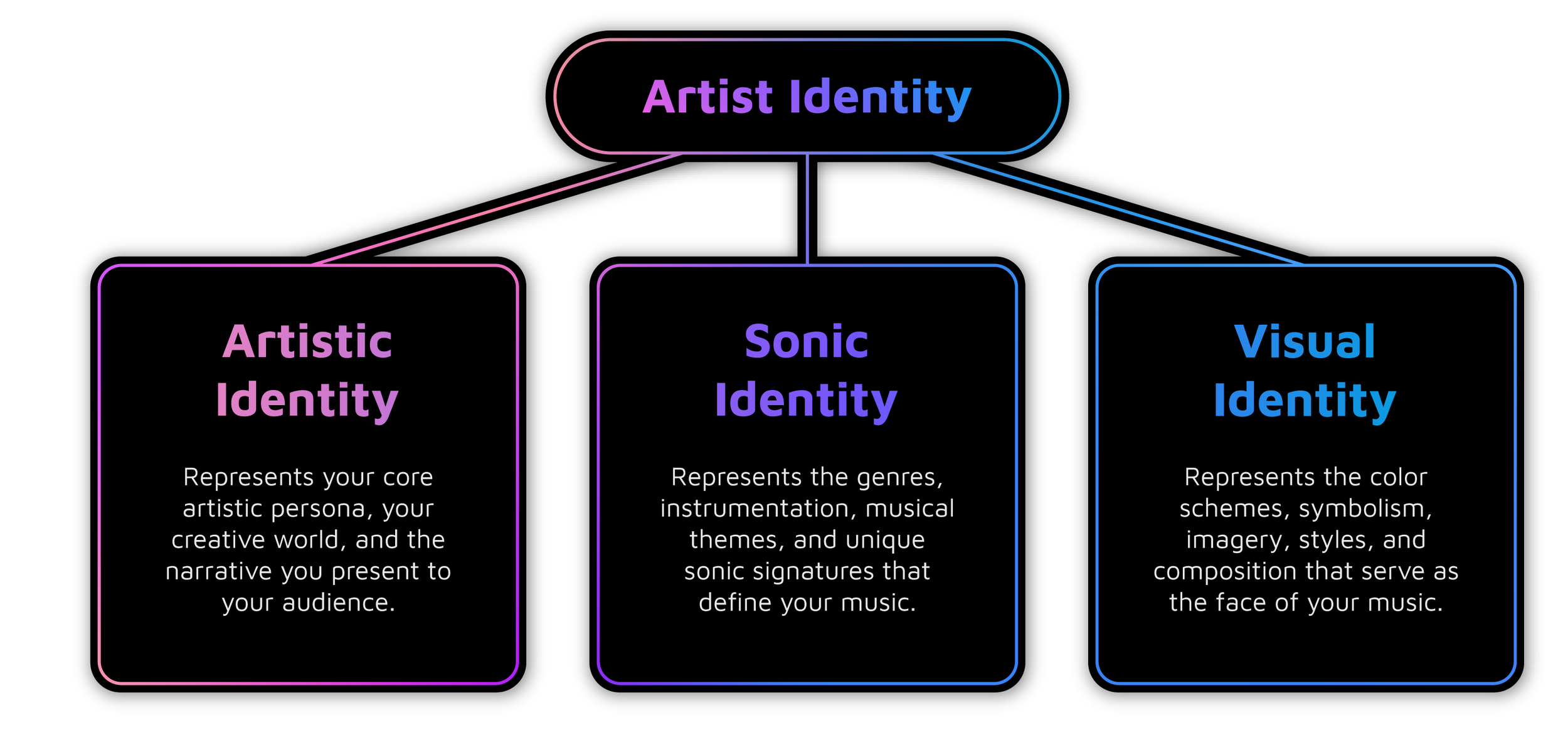
Let’s cover the basics first: Conceptual Identity most broadly refers to the world that the artist lives in, the things that the artist experiences and intangible aspects of their experiences that their art helps them to access. For a cello soloist, maybe they’re using their music to reflect on the beauty of life in a way that they otherwise couldn’t. For a dance pop artist, maybe they’re using their music to express the excitement of being out on the dance floor.
Regardless of what kind of music you make, there will always be a driving force that compels you to make music in order to express something that you otherwise wouldn’t be able to. This is the core of your Conceptual Identity.
Conceptual Identity doesn’t stop there however. As important as the inner world of the artist is, their external world is just as important. And this world goes far beyond the place and time that they live—again we’re looking through a conceptual lens here. In fact, it is often the collision of the inner and outer experience that drives an artist to create.
For example, let’s take an artist like Adele. Her literal world is early 21st century England—but that’s not the world she lives in as an artist. As an artist, her world is one of breakups, romance, and family. Her music chronicles her journey as she attempts to reconcile that external world with her internal world—one full of nostalgia, desire, and a longing to connect. It is within this dichotomy that her world takes form, and with every song she gives fans a chance to enter her world and join her in touching something they otherwise would never have access to.
That is what you are as an artist—an access point for others to tap into something they otherwise wouldn’t be able to reach.
Your Conceptual Identity is what allows others to walk into your world and experience what only your music can give them.
Your Conceptual Identity will feed into both your Sonic Identity and your Visual Identity, but it will also be expressed in other tangible ways outside of your music and your visuals. We’ll talk more about that in a minute, but first, let’s talk about how to go about building your world and finding your Conceptual Identity.
How to Find Your Conceptual Identity
Your Conceptual Identity may not be immediately evident, but believe it or not, you probably have already developed a lot of it just by virtue of having written music. Your world, the things that inspire you, and the themes that inform your music are all a part of your Conceptual Identity. Because of this, looking at your music is the perfect place to start.
Before we dive into too many specifics, think more generally about the music that you’ve written. What are the common themes present in your music? What kinds of things do you talk about in your lyrics? What kind of atmosphere does the music itself create? How does your music make people feel? Write down the things that define your music broadly and consider what kind of world this is presenting to your audience and what kind of artist is reflected in that world.
Once you’ve had a chance to think things through in general terms, look more specifically at the songs you’ve written. Choose 5-10 songs that you consider to be your most important works. For each one, take inventory of what makes them stand out. What makes them significant to you? Write down what resonates most to you as an artist for each.
Then, take a look at what you’ve written and compare the songs on your list. Are there common themes across your songs? Are there any themes that only appear once or twice but that feel very important to you as an artist? Write them down or circle them to come back to later.
Finally, look at everything you’ve been able to draw from your music so far. What other themes do you think are important to you and your world that you haven’t written down? Is there anything important that may not have come up in the assessment of your music alone?
Once you’ve gone through and added any other significant elements, take everything that you have and make a new list that includes all of the elements that you’ve identified as key parts of your world and artistic work. These are the key elements of your Conceptual Identity, and are what we’ll use to build your artistic world, your artistic persona and your overall presence as an artist.
To make it easy, we’ve also created a downloadable version of this assessment that you can use to guide you through this process:
► Artistic World & Vision Assessment
Okay, let’s turn our attention to another crucial part of your Conceptual Identity: your performative style. So far everything we’ve talked about covers the “what” when it comes to Conceptual Identity, but the way that those elements are conveyed is also incredibly important—and to be honest, the framework is pretty simple. For every artist there are two different extremes to draw from: the authentic and the dramatic. Some artists are way out on the poles of these extremes, whereas many will find themselves at home somewhere in the middle.
Regardless of where you are on that spectrum, it’s critical that you figure out what feels best to you when it comes to sharing your art with the world. Highly dramatic artists will lean into much more showy, high-concept themes when communicating their art, and will often develop their artistic persona as someone completely detached from who they are in real life. Think Daft Punk or early Lady Gaga.
++
Now that you’ve found the elements of your artistic world and vision that exist within your music, it’s time to think about your Conceptual Identity in broader terms. To do this, we’ll focus on three categories: how you define yourself as an artist, the things that are meaningful within your artistic world, and the emotions that your music invokes.
To simplify this, we’ve created an exercise that helps you get super focused in each of these categories. In this exercise you’ll see a pretty detailed list of descriptors for each of these categories. Go through each list, highlighting the descriptions that you feel best align with your Conceptual Identity. Write in additional descriptors in the spaces we’ve provided when it’s helpful to do so as well.
As you do this, you’ll start to see a much clearer vision of who you are and how that reflects to your audience. This will be extremely helpful as we go through the next steps and begin implementing your Conceptual Identity in was that people will actually be able to see, and that will drive home what your art is all about.
Bringing your Conceptual Identity to Life